A greener spirit: the rise of sustainable English whisky
Can English whisky make sustainability part of its identity? My 2025 feature for Brewer and Distiller International, now online for the first time.

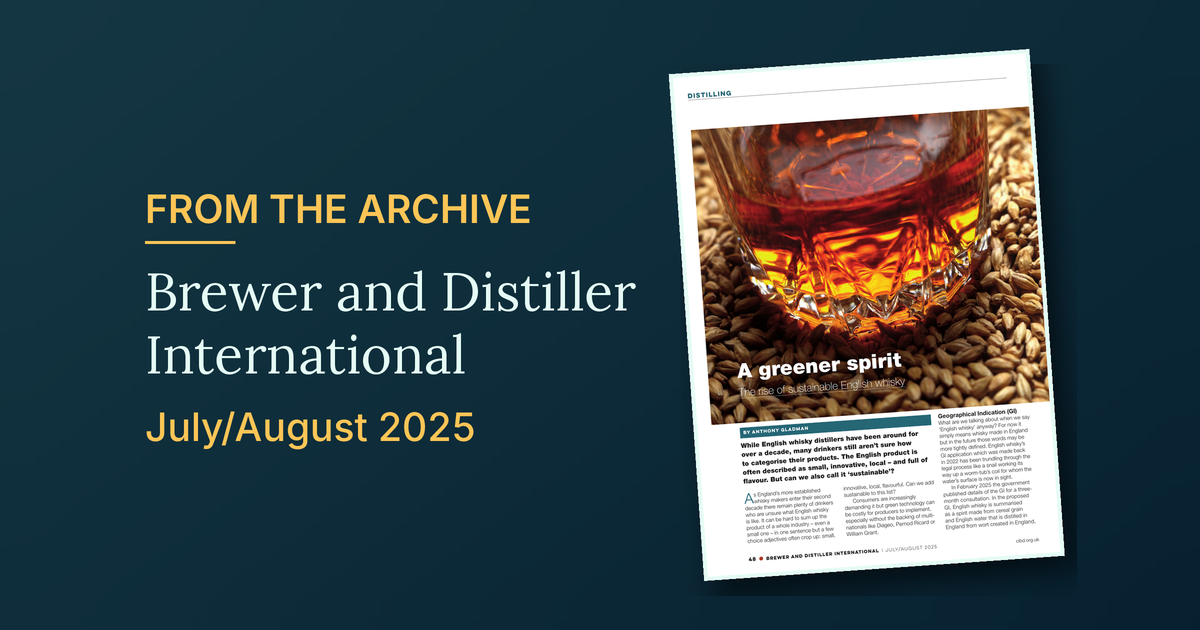
This feature ran in the July/August 2025 issue of Brewer and Distiller International, the journal of the Chartered Institute of Brewers and Distillers.
I wanted to know whether English whisky, still young enough to be working out what it is, could make sustainability part of its identity from the start. What I found was a sector heading in broadly the same direction while disagreeing, sometimes sharply, about how to get there.
Since publication:
- The English whisky GI came into force on 1 October 2026, though it has since faced appeals.
- Ellers Farm's first whisky is due for release tomomrrow, 23 October 2026.
- There's no public sign yet of the EWG's sustainability roadmap; the GI seems to have taken up most of the Guild's attention for now.
The best quote that didn't make the cut:
Liam Hirt of Circumstance, not a fan of the GI, on what he saw as the undue influence of English whisky’s larger and more Scotch-like distillers:
They're knocking on the door of the Scots saying we want part of that massive pie that is Scotch whisky – even a small slice would be great – as opposed to creating a new pie.
While English whisky distillers have been around for over a decade, many drinkers still aren't sure how to categorise their products. The English product is often described as small, innovative, local – and full of flavour. But can we also call it 'sustainable'?
As England's more established whisky makers enter their second decade there remain plenty of drinkers who are unsure what English whisky is like. It can be hard to sum up the product of a whole industry – even a small one – in one sentence but a few choice adjectives often crop up: small, innovative, local, flavourful. Can we add sustainable to this list?
Consumers are increasingly demanding it but green technology can be costly for producers to implement, especially without the backing of multinationals like Diageo, Pernod Ricard or William Grant.
Geographical Indication (GI)
What are we talking about when we say 'English whisky' anyway? For now it simply means whisky made in England but in the future those words may be more tightly defined. English whisky's GI application which was made back in 2022 has been trundling through the legal process like a snail working its way up a worm-tub's coil for whom the water's surface is now in sight.
In February 2025 the government published details of the GI for a three-month consultation. In the proposed GI, English whisky is summarised as a spirit made from cereal grain and English water that is distilled in England from wort created in England, at an alcoholic strength of less than 94.8% by volume, in such a way that the distillate has an aroma and taste derived from the materials used. It must be matured in England in wooden casks of no more than 700 litres for a minimum of three years, and bottled at a minimum of 40% ABV.
For some distillers this GI marks a coming of age for the sector. It is an important step to ensure the quality of English whisky and protect the reputation it has been steadily building on the world stage.
However, support for the GI within the English whisky industry is by no means universal. Some producers complain "that the GI echoes Scotch too closely, that it's too soon, that it's overly prescriptive".
Grain
When it comes to sustainability, one area to chew over is grain. The GI stops short of compelling English whisky distillers to use English grain, instead allowing them to choose the suppliers from anywhere in the UK.
"We talked about this, about whether English whisky should be made from English grain," says Liam Hirt, co-founder of the Circumstance Distillery in Bristol which was a founder member of the English Whisky Guild (EWG) but chose to leave over differences of opinion over the GI including, but not limited to, the issue of grain.
"For me it was a no-brainer. Of course it should be made from English grain. There's no reason why it shouldn't be."
For Hirt, omitting this from the GI was a missed opportunity to make English whisky more sustainable by definition. The GI argues the use of Scottish grain (plus, technically, Welsh and Northern Irish but let's not kid ourselves here…) allows more resilience in the face of crop disease and climate change.
The GI documents also cite the example of English distilleries close to the border with Scotland for whom "it would not be viable to ensure the grain was grown in England".
Peat
Peat is another issue. The White Peak Distillery's Wire Works whisky contains 20% peated malt. The English Smokey from The English Distillery also uses peated malt; some of its spirit also ends up as Sacred's Peated English whisky.
For each of these, English grain makes its way across the border to be peated in Scotland before returning to England to continue on its path towards the glass. To further complicate matters, these batches of grain may return with a Scottish accent that's down to more than just peat smoke. Maltings might not keep individual loads of grain separate in their normal production cycle (although many do), so Scottish grain may well end up in the mix too.
Some distillers argue that allowing English whisky to be made from peated grain, and accepting the associated food miles and emissions, amounts to a missed chance to bake sustainability into English whisky's DNA.
Hirt says that as well as being greener, moving away from peat would have been a good way for English whisky to differentiate itself from Scotch. "We're English. We do have peat bogs but it's not part of our heritage burning peat like it is in Scotland. Let's just not do it, let's leave the peat in the ground and make unpeated whiskies. Whisky is not a necessity, it's a luxury. If we're making a luxury we should be doing as little damage as possible."
There are other options open to English distillers who want a peaty flavour. Many achieve a more gentle peat profile by finishing their spirit in barrels that previously housed Islay whiskies. Nor is peat the only way to achieve smoky flavours in a whisky. Hirt has used wood smoke, which imparts barbecue flavours rather than TCP and menthol. "Barbecue flavours are awesome. Everybody loves barbecue flavours," says Hirt.
The Guild
Morag Garden, CEO of EWG, says sustainability is a journey, and while the direction of travel may be the same, each distillery must chart its own path. "All distilleries are boats in the same storm," says Garden. "They're all having to lean in onto their own focus area or their hotspot or their passion, while also all dealing with this wider climate crisis."
Before joining the EWG Garden worked on sustainability strategy for the Scotch Whisky Association. She says when it comes to sustainability, English whisky's biggest strength is also its biggest challenge. English whisky makers are small and new which makes them agile and able to quickly adopt the latest technology, such as carbon capture, hydrogen or thermal vapour recompression. But this also means they lack the access to resources, investment capacity and economies of scale that distilleries in Scotland enjoy.
Still, she remains upbeat about it. "English whisky is modern, so we can definitely take advantage of integrating sustainability into the design from the beginning," says Garden. "Sustainability is core to all businesses now and that's where a lot of our members are starting from."
The EWG works by fostering collaboration, sharing stories of its members' successes, their investments and their collective progress. It also facilitates the exchange of knowledge and best practices so members can learn from each other. Lastly, it ensures its members are informed of evolving environmental policies and advocates for regulations that support their sustainability objectives.
The EWG often works in partnership with the government and academia, sometimes separately and sometimes together, to co-ordinate and fund research and to help its members access sustainable technologies. One recent example of this was the Green Distillers Fund. "Part of my role would be to lean into that R&D government funding to help members pilot and trial to move us along on this journey," says Garden.
Is there more the EWG could be doing? Garden thinks so and says it could take its lead from another spirits trade association and emulate recent work by the Gin Guild to build a sustainability roadmap for its members.
"I want to create a sector roadmap that is bespoke to my members, inspiring them towards a sustainable future, improving efficiencies, reducing our impacts on the climate and nature and helping them contribute to the UK net zero agenda."
While the EWG can lay out a roadmap and encourage its members to sign up to joint targets, its role does not extend to dictating how its members achieve them. "As a trade association, you can't tell your companies what to do. They've got to make that business decision themselves. You just highlight what is there then encourage them with the benefits of following it," Garden says.
Size and structure
It's easy to forget or ignore just how small the English whisky sector is. The craft distilling boom in England has not spread to whisky anywhere like as much as it has in other countries. By some estimates English whisky accounts for just 2% of the UK's luxury dark spirits market.
Fewer than 12% of England's distilleries make whisky. Most of the ones that do are tiny, with English whisky sales dominated by a half dozen of the larger distilleries.
Many of England's new distillers have chosen instead to focus on gin, which requires less capital expenditure to get going – and once your stills are up and running, no expensive barrels or warehouses for maturation. It seems unlikely that these single-spirit operations will reinvest and be laying spirit down for whisky now that gin sales have weakened.
English whisky isn't going to reach the same scale as Scotch anytime soon. English whisky makers are small and they are likely to remain small. Scotland's largest whisky distillery is 200 times the size of England's. Forcing them to operate in particular ways would be neither appropriate nor feasible and would risk stifling the innovation for which this small but significant market segment is known.
Any new distilleries will benefit from newer technology and face more pressure to be sustainable from the start. But there may not be too many of those on the horizon in any case. According to spirits expert Olivier Ward: "Reaching 100 English whisky makers is unlikely to happen before 2030. Therefore it's those who are in the market already that will shape its identity, credibility and establish its potential."
We still don't know what will happen to the GI after the public proposal ends in May. It may be passed as is, or it may be altered. Any back and forth over using English grain doesn't seem to matter so much when you consider that most English whisky makers use English grain anyway.
The future direction of English whisky is unclear but one way or another, GI or not, it will have to walk down the road towards sustainability. All it takes is for just a few of English whisky's bigger players to pull in the same direction and sustainability becomes one of the watchwords almost by default.
What have England's whisky makers done to be greener?
Here we take a snapshot of what selected English whisky distillers are doing to minimise their environmental impact:
Circumstance Distillery is certified carbon neutral. It uses organic grain grown as locally as possible and malted about 30 miles away at Warminster Maltings. The commitment to sustainability continues into its packaging too. Circumstance uses lightweight glass bottles made from 100% recycled glass. It will refill those bottles for customers at the distillery, or customers can refill them at home from aluminium cans posted in plastic-free packaging. For the hospitality trade, the distillery offers 5-litre bulk containers. The distillery also makes local deliveries by cycle courier.
Adnams uses barley that is grown and malted locally. Once Adnams has finished with it, the draff ends up as animal feed or goes to an anaerobic digester. It powers its distillery entirely from renewable sources and uses a closed loop heat recovery system that runs between its distillery and its brewery that sees 90% of the brewery's steam transformed into heat for its stills.
It has reduced its water use by approximately two million litres a year, and harvests one million litres of rainwater each year at its nearby distribution centre, which it uses to wash its trucks and flush its toilets.
It has also reduced electricity use at its distribution centre by making its walls out of lime and locally grown hemp. It uses lightweight glass for its bottles and is reducing the amount of plastic it uses in its packaging.
Cooper King produces what it says is England's first net zero whisky. It does this with the help of some carbon offsetting. The distillery uses only English barley, though it is malted 260 or so miles away at Warminster which does add some road miles to the equation.
It has run on 100% renewable energy since it began and has also installed 40kW of solar panels plus 30kWh of battery storage and a dual electric vehicle charger. Its closed loop cooling system saves about 26 tonnes of emissions per year.
It uses vacuum stills to produce its gin and vodka, and its whisky still has heating coils that sit within the wash. This makes it as energy efficient as a direct fired still and is augmented by the microbead paint that coats the still – the same stuff NASA uses to protect its spaceships from burning up on re-entry. This reduces heat loss and its associated energy costs by about 20%.
The distillery does not send any waste to landfill. Its draff goes to farms for animal feed and everything else is either recycled or sent to an anaerobic digester plant 17 miles away. It uses lightweight bottles made from 55% recycled glass and fitted with stoppers that use a top made from FSC certified wood and a shank made from NEOS.
This composite material is made from renewable sugar cane derivatives and recycled polymers. The shank is co-injected into the wooden head, which means it is almost unbreakable and requires no glue. Its postal packaging is also entirely plastic free.
The Cotswolds Distillery also uses locally-grown barley. In 2021 the distillery bought six acres of horse pasture that adjoined its land and turned it into a wetland with over 50 species of wildflowers, reeds and willows that act as a biological filtering system for its white water effluents.
All the distillery needs to do is pump the effluent to the top of the wetlands, which are built on a gentle slope, and let gravity, the plants, and evaporation do the rest. It can treat 100,000 litres of effluent each week. The distillery is working towards B-Corp status.
Ellers Farm Distillery is committed to reaching Net Zero by 2040 and halving its carbon emissions by 2030, from a 2023 baseline. As part of this, it aims to create a carbon neutral whisky from wash made at the nearby Theakston Brewery.
It uses 40% lighter glass bottles made from 68% recycled glass, and also 100% recycled 5cl aluminium bottles for travel retail. For its on-trade accounts it has lightweight reusable 10 litre Poly containers.
It is B-Corp certified and spends 2.3% of its revenue to offset emissions and fund environmental projects, as well as sharing 20% of its profits with employees. Its first whisky is scheduled for release in late 2025.
The English Distillery uses locally-grown barley, malted about 60 miles away at Crisp Maltings in Fakenham. It draws its water from the Breckland Aquifer which runs underneath the distillery and is pumped at a stable 10°C and kept within a closed seal loop before being returned to the ground after use. This reduces ground water use by 94%. The distillery gets 48% of its power from solar panels, and is exploring the use of hydrogen to further reduce its reliance on fossil fuels.
The Spirit of Yorkshire Distillery uses regenerative farming practices to grow all the barley it uses and sends it just 20 miles or so down the road to Bridlington to be malted. By using direct drilling and crop rotation, cover crops, and strategic grazing, it not only avoids carbon emissions associated with disturbing the soil but also improves soil health to keep carbon and nitrogen sequestered in the ground.
It uses water drawn from aquifers in the chalk directly below the farm for all stages of distillation. It sources its packaging from local suppliers and has moved its outer packaging to recycled cardboard.
Witchmark Distillery, which is working towards B-Corp status, uses local and regeneratively-farmed barley. It uses water drawn from its own borehole and employs a closed-loop system for optimal efficiency. It uses bio-liquid propane gas to power its stills, which are 40% more sustainable than fossil fuels. It also plans to install a 100kW solar array on its warehouse roof to meet its annual target of a 2% reduction in pro-rata energy consumption.