Why I don't do Dry January
Finding your own mindful rhythm beats performative abstinence

I am at my desk. It is a bleak Friday afternoon in January. The weather’s bleak, the news is bleak, the economy is bleak… it’s enough to drive you to drink.
I have a glass by my elbow as I type this, filled with one of the many samples in my fridge that are waiting to be tasted.
This one’s non-alcoholic. A kombucha. It’s delicious — light, clean and refreshing with distinct yet balanced flavours of basil, mint, citrus and tea.
It doesn’t make me feel smug when I drink it. It doesn’t make me feel virtuous, nor like I’m missing out on a boozy kick. It’s just something to drink that is nice and doesn’t get in the way too much. I got this for free but having tasted it I’d gladly buy some with my own money.
Isn’t that nice? Isn’t that what all drinks are aiming for in the end?
People send me samples fairly often. It might be that they hope I will write about their product. It might be that they are just interested in what I thought and felt when I tasted it. Or it might simply be that they are interested in keeping a relationship going, keeping that door open for whatever may come in the future.
Either way, there’s always something to drink. Often I also have a vague guilty feeling that I really owe it to someone else to drink, even if I might not feel like it. Because I’ve accepted a sample and now there’s a conversation going, and I have to keep my end up.
Sometimes, especially at Christmas, the true indulgence is drinking what you really want in the face of social pressure to do otherwise. This might include drinking less at a time when everyone seems hell-bent on necking booze non-stop. It could mean drinking something non-alcoholic instead of more mulled bloody wine.
And then in January it flips. Dry January puts the pressure on to be abstinent in a performative way that taps into the same social anxieties and pressures that we see driving the success of Instagram wellness influencers. Again, perhaps the real wellness lies in listening to yourself. In drinking if you want, but doing so mindfully.
Drink when you want to; don’t drink when you don’t. Find a healthy rhythm in your own life and then stick to that year round. It’ll drift this way and that; a bit more one month and a bit less the next. But that is better than great swings – excess in December, self-denial in January – that we allow others to impose upon us.
Of course this assumes a base-level relationship with alcohol that some people just don’t have. Alcoholism and addiction are real illnesses that cause terrible suffering. But that is (thankfully) not my situation, which is why I don’t write about it.
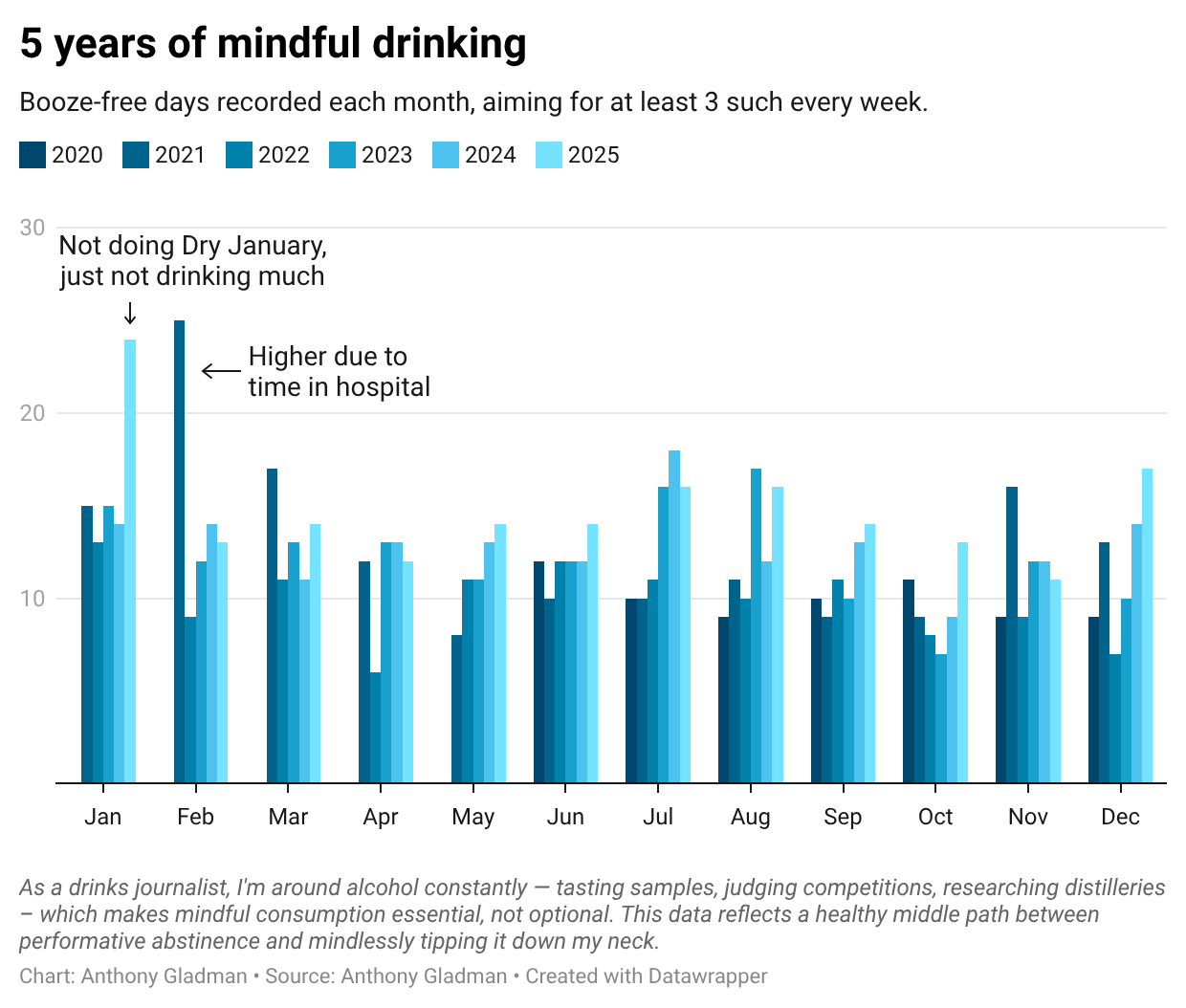
I find it helpful to keep a tally of days I drink alcohol and days I don’t. Nothing complicated, just a binary yes or no, and an aim to have at least three days off the booze each week. That’s all it takes for me to stay within healthy limits, despite working in an industry that can normalise and encourage dangerous levels of consumption. (If you recognise yourself here, check out The Drinks Trust.)
Anyway… it’s Friday evening. The first one of the year. I’ve not had any booze since New Year’s Eve. Soon I will go downstairs, crack open a bottle of something nice, and have one or two drinks with some pizza while I stream a crappy-but-entertaining film – January be damned.